Have you ever looked at a giant elephant and wondered, “How many of me would it take to be that tall?” or looked at a tiny ladybug and thought about how small it really is? Maybe you’ve stared at a ruler in class and wondered why one side says “inches” and the other says “centimeters.”
Welcome to the world of measurement! At Kids Learn Zone, we believe that math isn’t just about numbers on a page; it’s about discovering the magic of the world around us. Are you a student looking for help with your math homework? Or a parent teaching your child about liters and milliliters? This guide makes learning about measurements easy for everyone.
1. Class 1 & 2 Spotlight: The Magic of Comparing
Before we ever pick up a heavy wooden ruler, we use our eyes, our hands, and our curiosity. For our youngest learners in Class 1 and 2, measurement is all about comparing. It’s about understanding the difference between “big” and “small.”
Playing with “Non-Standard” Units
Did you know you can measure your bed using your favorite teddy bears? Or measure your desk using paperclips? These are called non-standard units. They are a fun way to start thinking like a scientist!
Why do we use them?
Because they are everywhere! If you don’t have a ruler, you can still find out how long something is by using blocks, handspans, or even your footsteps.
Worksheet Part 1: Beginner Comparisons (Class 1-2)
- Q1: The Heavy Challenge
Which is heavier: A fluffy cat or a tiny feather?
Answer: The cat! (Even though feathers are pretty, they have very little weight). - Q2: The Length Test
Which is longer: Your toothbrush or a spoon?
Answer: Usually, a spoon is longer. Go to your kitchen and check! - Q3: Non-Standard Fun
If your pencil is 6 paperclips long and your eraser is 2 paperclips long, which one is shorter?
Answer: The eraser is shorter.
2. Miles and Kilometers: The Long Road
When we talk about driving to another city or how far the moon is, we use big units. In the “Incredible Measurements” curriculum, we often compare Miles (Imperial) and Kilometers (Metric).
Did you know? A Mile is longer than a Kilometer. In fact, 1 Mile is about 1.6 Kilometers.
How to read the Scale
Imagine a line where 0 is the start. If you walk 5 miles, you have actually walked about 8 kilometers! This relationship helps us understand maps when we travel to different countries.
Worksheet Part 2: Miles and Kilometers (Section A)
- 1 mile = 1.60934 kilometers.
- 5 miles is approximately 8 kilometers.
- 8 miles is nearly 13 kilometers.
- 3 kilometers is nearly 2 miles.
- 12 kilometers is approximately 7.5 miles.
- If 10 miles is 16 km, then 1 mile is approximately 1.6 km.
3. Inches and Centimeters: The Ruler Secret
Look at your ruler. One side has big spaces (Inches) and the other has small spaces (Centimeters).
The Conversion Rule:
One inch is exactly 2.54 centimeters. This is a very important number to remember!
- To go from Inches to cm: Multiply the number by 2.54.
- To go from cm to Inches: Divide the number by 2.54.
Worksheet Part 3: The Ruler Master (Section B)
Length Conversions in Words
- 2 inches equals 2 multiplied by 2.54, which is 5.08 cm.
- 3 inches equals 3 multiplied by 2.54, which is 7.62 cm.
- 9 cm equals 9 divided by 2.54, which is 3.54 inches.
- 4 cm equals 4 divided by 2.54, which is 1.57 inches.
- 15 inches equals 15 multiplied by 2.54, which is 38.10 cm.
- 50 cm equals 50 divided by 2.54, which is 19.69 inches.
Real-World Math: Solving Word Problems Together
Sometimes, a math problem feels like a little mystery waiting to be solved. You just have to find the right clues to put the puzzle together! Let’s walk through a problem many students see in class.
The Ribbon Challenge
The Problem: Imagine you have a beautiful, long blue ribbon that is 2 meters long. Your teacher asks you to cut it into smaller pieces to make bookmarks for your friends. Each bookmark needs to be 10 cm long. How many bookmarks can you make?
How We Solve It (Step-by-Step):
- Step 1: Make the units match! Right now, we have “meters” and “centimeters.” We can’t divide them when they are different! Let’s turn those big meters into friendly centimeters first. (Since 1 meter is 100 cm, then 2 meters equals 200 cm).
- Step 2: Do the math. Now that everything is in centimeters, we can solve it easily. Take your 200 cm of ribbon and divide it by the 10 cm pieces.
The Calculation: 200 divided by 10 equals 20.
The Final Answer: Success! You just made 20 incredible bookmarks to share with your classmates!
5. Kitchen Capacity: The Mystery of Liquids
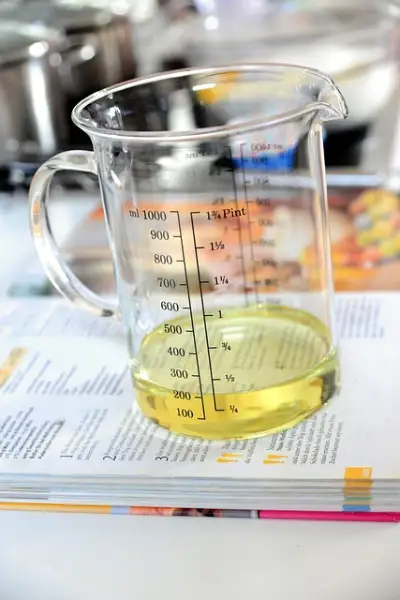
Have you ever helped bake a cake? You might see “ml” or “L” on the measuring cups. This is Capacity it tells us how much liquid a container can hold.
- Milliliters (ml): We use these for tiny amounts. Think of a raindrop, a spoonful of honey, or a small juice box.
- Liters (L): We use these for big amounts. Think of a large bottle of water or the fuel in a car.
Worksheet Part 4: The Kitchen Chemist
- Q1: Which unit would you use to measure a Bathtub? (milliliters or liters)
Answer: Liters, because a bathtub is huge. - Q2: A juice box has 250 ml. If you drink 4 juice boxes, how many Liters did you drink?
Solution: 250 multiplied by 4 = 1000 ml. Since 1000 ml is equal to 1 Liter, the answer is 1 Liter. - Q3: Which is more: 500 ml or 1 Liter?
Answer: 1 Liter (because 1 Liter is 1000 ml).
6. The “Incredible” Pet Challenge
Since we love animals at Kids Learn Zone, let’s use our measurement skills on our furry friends! Imagine you have a colorful Parrot named Pip. Pip is 25 cm tall. You also have a friendly Golden Retriever dog named Goldie. Goldie is 60 cm tall.
Worksheet Part 5: Animal Math
- Q1: What is the difference in height?
Math: 60 cm – 25 cm = 35 cm. (60 cm minus 25 cm equals 35 cm.)
Answer: Goldie is 35 cm taller than Pip. - Q2: The Stacking Challenge
If three Parrots stood on top of each other’s heads, would they be taller than Goldie?
Math: 25 + 25 + 25 = 75 cm.
Answer: Yes! Because 75 cm is more than 60 cm.
7. Mastering Time: “How Long Until Lunch?”
Reading an analog clock (the one with hands) is one of the most important measurements you will ever learn. It helps you know when your favorite cartoon starts!
- The Hour Hand: The short one.
- The Minute Hand: The long one.
Worksheet Part 6: The Clock Watcher
- Q1: If the short hand is on 3 and the long hand is on 12, what time is it?
Answer: 3:00. - Q2: If you start your homework at 4:00 PM and finish at 5:30 PM, how long did it take?
Answer: 1 hour and 30 minutes. - Q3: How many minutes are in 2 hours?
Answer: 120 minutes (60 minutes in 1 hour).
8. Perimeter and Area:
For our Grade 4 and 5 students, measurements get a bit more “flat.” We start looking at shapes.
- Perimeter: Think of a fence around a garden. To find it, you add all the sides together.
- Area: Think of the grass inside the garden. To find it, you multiply the length by the width (L multiplied by W).
Worksheet Part 7: Shapes and Spaces
- Q1: The Square Garden
A square has 4 sides, and each side is 5 meters. What is the Perimeter?
Math: 5 + 5 + 5 + 5 = 20.
Answer: 20 meters. - Q2: The Carpet Area
Your room is 4 meters long and 3 meters wide. How much carpet do you need?
Math: 4 x 3 = 12.
Answer: 12 square meters.
9. The “Incredible” Yards Challenge
In your worksheet, you might see a very hard question about “Yards.” A Yard is an old way of measuring, but it is still used in sports like football.
- 1 foot = 12 inches
- 1 yard = 3 feet (which is 36 inches)
Problem: How many centimeters are in 1 yard?
Solution: We know 1 yard is 36 inches. We know 1 inch is 2.54 cm.
Math: 36 multiplied by 2.54 equals 91.44.
Final Answer: There are 91.44 cm in 1 yard.
Length
| 10 Millimeters | 1 Centimeter |
| 10 Centimeters | 1 Decimeter |
| 10 Decimeters | 1 Meter(m) |
| 1 Meter | 100 Centimeters(cm) |
| 10 Meters | 1 Decameter |
| 10 Decameters | 1 Hectometer |
| 10 Hectometers | 1 Kilometer(km) |
| 1 Kilometer | 1000 m |
10. Activity Time
We don’t want you to just read—we want you to DO! Print this table and find these items in your house.
| Item | My Guess (Estimate) | Real Measurement |
| Your favorite spoon | ||
| A TV remote | ||
| Your shoe | ||
| A storybook |
What are 10 examples of measurement in our daily life?
Distance (Length): Measures how long an object is or the space between two places (e.g., measuring a pencil in cm or a road in km).
Weight (Mass): Measures how heavy an object is (e.g., weighing a bag of flour in grams or a person in kg).
Volume (Capacity): Measures how much liquid a container can hold (e.g., a small juice box in ml or a large bucket in liters).
Time: Measures the duration of an event or the interval between them (e.g., a race in seconds or a school day in hours).
Temperature: Measures how hot or cold something is (e.g., the weather or a person’s body heat in Celsius).
Speed: Measures how fast something is moving (e.g., a car traveling at 60 km/h).
Area: Measures the size of a flat surface (e.g., the amount of grass in a backyard in square meters).
Perimeter: Measures the total distance around the outside of a shape (e.g., the length of a fence around a garden).
Money (Value): Measures the cost of items (e.g., buying a toy for 10 dollars or rupees).
Angle: Measures the amount of turn between two lines (e.g., using a protractor to find a 90° corner)
What are some fun questions about measurement?
Which is heavier: A ton of bricks or a ton of feathers? (Trick question—they are the same weight!)
How many centimeters are in a meter? (There are 100).
If a bottle holds 500 ml, how many bottles do you need to make 2 Liters? (You need 4 bottles).
What tool do you use to measure the temperature of a liquid? (A thermometer).
What is a short trick for learning measurement?
The best trick for the Metric System is this famous sentence: “King Henry Died Unusually Drinking Chocolate Milk.”
This helps kids remember the order of units from largest to smallest:
Kilo (King)
Hecto (Henry)
Deka (Died)
Unit – Meter, Liter, Gram (Unusually)
Deci (Drinking)
Centi (Chocolate)
Milli (Milk)
What are the essential questions for measurement?
In education, “Essential Questions” help kids think deeply about why math matters:
Why do we need a standard unit (like a meter) instead of just using our own feet?
How does the tool we choose affect how accurate our measurement is?
When is it okay to estimate, and when do we need an exact number?
What is the 7x11x13 trick?
This is a “magic” math trick. If you take any 3-digit number and multiply it by 7, then 11, then 13, the result will be the original number written twice!
Example: 254 x 7 x 11 x 13 = 254, 254.
Why does it work? Because 7 x 11 x 13 = 1001. Any 3-digit number multiplied by 1001 simply repeats itself.
How do you say “I love you” in math?
There is a famous equation for this:
128⎷e980
If you write this on a piece of paper and erase or cover the top half of the numbers and symbols, the bottom half spells out “I Love You.
What are the 7 types of measurement?
In physics and standard science, there are 7 base units (known as SI Units):
Length (Meter)
Mass (Kilogram)
Time (Second)
Electric Current (Ampere)
Thermodynamic Temperature (Kelvin)
Amount of Substance (Mole)
Luminous Intensity (Candela)
What is the answer to 8 ÷ 2(2+2)?
This is a famous viral math problem that tests your knowledge of PEMDAS/BODMAS (the Order of Operations).
Parentheses/Brackets first: (2+2) = 4.
The equation becomes: 8 ÷ 2 x 4.
Move Left to Right: 8 ÷ 2 = 4.
Final step: 4 x 4 = 16.
The final answer is 16.
What are the 7 basic units of measurement?
Length: Meter (m)
Mass (Weight): Kilogram (kg)
Time: Second (s)
Electric Current: Ampere (A)
Temperature: Kelvin (K)
Amount of Substance: Mole (mol)
Luminous Intensity (Brightness): Candela (cd)
How to explain measurement for kids?
The best way to explain it is as a “Counting Tool.” Tell them: “Measurement is a way for us to find out exactly how big, how heavy, or how long something is. Instead of just saying a tree is ‘tall,’ measurement lets us say exactly how many rulers tall it is! it helps us compare things fairly.”
What are the two types of measurements?
Metric System: Used by almost every country. it uses units like meters, grams, and liters. It is easy because it works in sets of 10.
Imperial System: Used mostly in the USA. It uses units like inches, feet, pounds, and gallons.
How to teach measurement for kindergarten?
For very young children, don’t start with rulers! Start with Comparing and Non-Standard Units:
Step 1 (Comparing): Use words like longer, shorter, heavier, lighter, bigger, and smaller. Ask, “Is the elephant heavier than the mouse?”
Step 2 (Non-Standard): Use everyday objects to measure. Ask, “How many paperclips long is your pencil?” or “How many footsteps wide is the rug?”
Step 3 (Hands-on): Let them play with water and cups to learn about “full” and “empty” (capacity).
What is measurement? (Short and easy answer)
Measurement is finding a number that shows the size or amount of something. It tells us “How much” of something we have like how much we weigh, how much water is in a bottle, or how much time has passed.
Conclusion: Why Measurement Matters
Measurement isn’t just about passing a test. It helps us build houses that don’t fall down, bake cookies that taste delicious, and even send rockets to Mars! When you practice your Incredible Measurements worksheets, you are learning how to be precise and careful. We hope this guide and the worksheet answers helped you feel like a math superstar today.
Visit our website Kids Learn Zone to find more incredible lessons and activities.