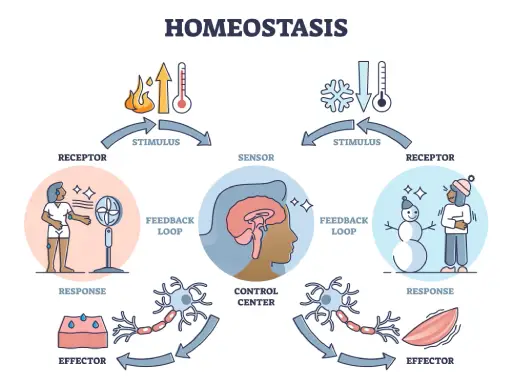
Have you ever stopped to think about how incredible it is that you don’t have to remind your heart to beat or tell your body to cool down after a race? There is a silent, brilliant “manager” inside you working 24/7 to keep everything running smoothly. This manager is called homeostasis.
If you are currently staring at a homeostasis worksheet to recognize normal parameters, you aren’t just doing a biology assignment. You are exploring the very engine of life. Let’s break down the science of balance with a little more heart and a lot of clarity.
A homeostasis worksheet helps students recognize normal body parameters such as body temperature, blood glucose, blood pressure, pH, and water balance. This guide includes easy explanations, practice questions, worksheets, and answer keys to improve biology knowledge and exam preparation.
What is Normal Homeostasis?
At its core, normal homeostasis is your body’s way of staying stable. Imagine you are walking a tightrope. To stay on the rope, you have to constantly shift your weight left and right. You never stay perfectly still, but you stay “balanced.”
Our bodies do the same thing. Even when the world changes—like when you eat a sour lemon or step out into the snow, your internal environment stays within a safe, healthy zone.
What is a Parameter in Homeostasis?
A parameter is simply a specific thing that your body measures. Think of it like the dashboard of a car. A car has parameters like speed, fuel level, and engine temperature. Your body has its own set of critical parameters:
- Body Temperature
- Blood Sugar Levels
- Water Content
- Oxygen Levels
What is a Normal Range in Homeostasis?
Your body doesn’t need to stay at one exact, frozen number. Instead, it stays within a normal range. For example, a “normal” body temperature is usually around 98.6°F, but it can safely go a little higher or lower. If you fall outside that range, your homeostatic system rings the alarm to bring you back to center.
Normal Homeostasis Parameters
The table below shows some of the most important normal parameters that your body regulates to maintain homeostasis.
| Parameter | Normal Range | Why It Is Important |
|---|---|---|
| Body Temperature | 37°C (98.6°F) | Keeps the body functioning properly |
| Blood Glucose | 70–100 mg/dL (fasting) | Provides energy for cells |
| Blood Pressure | Around 120/80 mmHg | Maintains healthy blood circulation |
| Blood pH | 7.35–7.45 | Supports normal enzyme and cell function |
| Oxygen Saturation | 95–100% | Ensures enough oxygen reaches body tissues |
| Heart Rate | 60–100 beats per minute (adults) | Maintains normal blood flow |
| Water Balance | Normal hydration level | Prevents dehydration and overhydration |
These normal homeostasis parameters work together to keep the body healthy. When one parameter moves above or below its normal range, the body activates negative feedback mechanisms to restore balance.
The 3 Components and 4 Steps: How It Works
To keep you in that “Goldilocks Zone” (not too hot, not too cold), your body uses a loop of communication.
The 3 Components of Homeostasis
- The Receptor (The Sensor): These are like the body’s security cameras. They notice when something changes, like your skin sensing heat.
- The Control Center (The Brain): The brain receives the message, checks the normal range, and decides if action is needed.
- The Effector (The Worker): These are the muscles or glands that actually do the work, like sweat glands releasing water to cool you down.
The 4 Steps of Homeostasis
Every time your body fixes a problem, it follows these four steps:
- Stimulus: A change occurs (e.g., you get scared, and your heart rate jumps).
- Detection: Receptors send a signal to the Control Center.
- Response: The Control Center tells the Effectors to act.
- Balance: The body returns to its normal parameter, and the system resets.
Why Is It Important to Recognize Normal Parameters?
Recognizing normal parameters is one of the most important parts of learning homeostasis. Doctors, nurses, biology students, and healthcare professionals use these values to determine whether the body is functioning normally or showing signs of illness.
For example, if body temperature rises above the normal range, it may indicate a fever or infection. Similarly, unusually high or low blood glucose levels can be a sign of diabetes or other health conditions. Understanding these normal values helps students complete a homeostasis worksheet, answer biology questions correctly, and better understand how the human body maintains balance.
10 Examples of Homeostasis in Action
Here is a list of how your body manages this balance every day. You’ll find these helpful for any homeostasis worksheet:
- Thermoregulation: Keeping your temperature steady.
- Blood Glucose: Managing energy from the food you eat.
- Hydration: Balancing water so your cells don’t shrivel or burst.
- Blood Pressure: Ensuring blood reaches your brain even when you stand up.
- pH Levels: Keeping your blood from becoming too acidic.
- Calcium Balance: Moving calcium into your bones or blood as needed.
- Gas Exchange: Managing oxygen and carbon dioxide through breathing.
- Waste Removal: Filtering out toxins via the liver and kidneys.
- Immune Response: Using a fever to fight off an infection.
- Iron Levels: Regulating the iron in your blood for healthy oxygen transport.
cerebrospinal homeostasis worksheet
Cerebrospinal Fluid (CSF) is a clear, watery liquid that flows around your brain and spinal cord. Homeostasis means keeping everything in a perfect balance.
So, Cerebrospinal Homeostasis is the way our body keeps the brain’s environment stable and healthy.
3 Main Jobs of CSF:
- Protection: It acts like a cushion or a “shock absorber” to protect the brain from injury.
- Nutrients: It carries food and oxygen to the brain cells.
- Waste Removal: It washes away waste products and toxins from the brain.
Cerebrospinal homeostasis worksheet answer
Part A: Fill in the Blanks
- CSF stands for ________________ Fluid.
- The liquid acts as a ________________ to protect the brain from bumps.
- ________________ is the process of keeping a stable balance in the body.
- The CSF travels around the ________________ and the ________________.
Part B: True or False
- CSF is only found in the stomach. (True / False)
- Homeostasis helps keep the brain healthy. (True / False)
- The brain floats in the cerebrospinal fluid. (True / False)
Answers for Part A:
- Cerebrospinal fluid
- Cushion (or Shock Absorber)
- Homeostasis
- Brain and Spinal Cord
Answers for Part B:
- False (It is found in the brain and spinal cord).
- True
- True (This buoyancy helps protect the brain’s weight).
For those looking for a Cerebrospinal homeostasis worksheet answer, this refers to the delicate balance of the fluid that protects your brain. This fluid (CSF) must maintain the right pressure and nutrient levels to keep your brain “floating” safely inside your skull. It’s like a high-tech shock absorber.
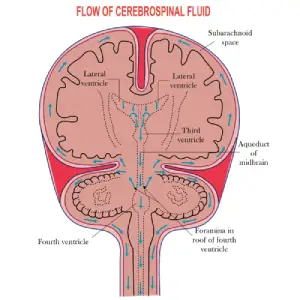
CSF is primarily produced in the Lateral Ventricles.
It flows through the interventricular foramina into the Third Ventricle.
It passes through the cerebral aqueduct into the Fourth Ventricle.
From there, it enters the Subarachnoid Space and the central canal of the spinal cord.
Finally, it is reabsorbed into the venous blood through the Arachnoid Villi (Granulations).
Practice Section: Homeostasis Worksheet
Use the practice sets to test your knowledge.
Worksheet : The Basics
- Fill in the Blank: The “stable state” of the body is called ____________.
- Multiple Choice: Which part of the loop decides how the body should react?
- A) Receptor
- B) Control Center
- C) Effector
- True/False: Homeostasis only happens when we are sleeping. (____)
Answer Key for Worksheets
Worksheet Answers:
- Homeostasis
- B) Control Center
- False (Homeostasis happens every second of your life!)
Homeostasis Worksheet Practice Questions
Match the Following
| Body Parameter | Function |
|---|---|
| Body Temperature | Regulates body heat |
| Blood Glucose | Provides energy to cells |
| Blood Pressure | Moves blood throughout the body |
| Blood pH | Maintains chemical balance |
| Water Balance | Prevents dehydration |
Choose the Correct Answer
1. Which organ controls body temperature?
A. Heart
B. Liver
C. Hypothalamus
D. Kidneys
Answer: C. Hypothalamus
2. Which hormone lowers blood glucose levels?
A. Glucagon
B. Insulin
C. Adrenaline
D. Thyroxine
Answer: B. Insulin
3. What is the normal human body temperature?
A. 35°C
B. 37°C
C. 40°C
D. 42°C
Answer: B. 37°C
4. Which process helps maintain homeostasis?
A. Negative feedback
B. Digestion
C. Respiration
D. Photosynthesis
Answer: A. Negative feedback
5. Which organ mainly regulates blood glucose?
A. Lungs
B. Pancreas
C. Skin
D. Stomach
Answer: B. Pancreas
Detailed Case Studies: Negative Feedback Loops
1. Body Temperature Homeostasis Worksheet
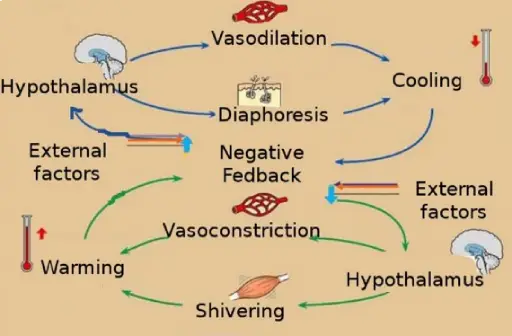
Body temperature homeostasis means the body keeps its temperature around 37°C (98.6°F).
When the body becomes too hot:
- Stimulus: Body temperature rises.
- Control Center: The hypothalamus in the brain detects the change.
- Response: Sweat glands produce sweat; blood vessels in the skin dilate (expand).
- Result: Heat leaves the body and temperature returns to normal.
When the body becomes too cold:
- Stimulus: Body temperature drops.
- Control Center: The hypothalamus detects the change.
- Response: Muscles start shivering; blood vessels in the skin constrict (narrow).
- Result: Heat is produced and temperature returns to normal.
2. Blood Glucose Homeostasis Worksheet
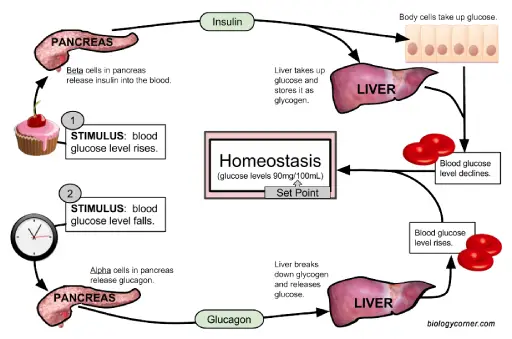
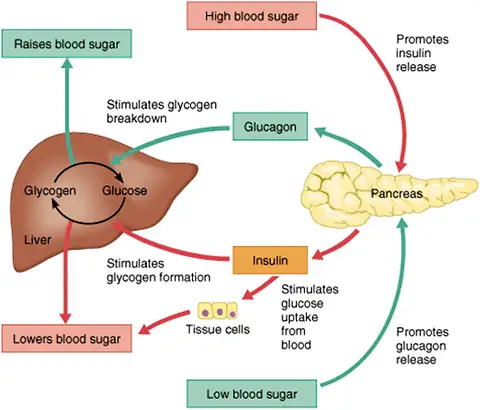
Blood glucose homeostasis means the body keeps the amount of sugar (glucose) in the blood at a normal level.
When blood sugar is too high (after eating):
- Stimulus: Blood glucose increases.
- Control Center: The pancreas detects the change.
- Response: Pancreas releases insulin.
- Effect: Cells absorb glucose; liver stores glucose as glycogen.
- Result: Blood sugar decreases to normal.
When blood sugar is too low (between meals):
- Stimulus: Blood glucose decreases.
- Control Center: The pancreas detects the change.
- Response: Pancreas releases glucagon.
- Effect: Liver breaks down glycogen into glucose; glucose enters the blood.
- Result: Blood sugar returns to normal.
Did You Know
1. The Shiver Secret
Question: Did you know your body can make its own heat?
The Fact: When you are cold, your muscles shake very fast. This is called shivering. It’s your body’s way of “exercising” to create heat and keep you at 37°C -98.6°F}
2. The Natural Cooler
Question: Why do we get wet when we run fast?
The Fact: That’s sweat! When your body gets too hot, it sends water to your skin. As the air blows on the water, it cools you down just like a fan. It’s like having a built-in air conditioner!
3. The Goosebump Guard
Question: Why do we get tiny bumps on our skin?
The Fact: Those are goosebumps! A long time ago, humans had more hair. Goosebumps would make the hair stand up to trap warm air near the skin. Even though we have less hair now, our “Homeostasis Boss” still tries to keep us cozy!
4. The Thirst Alarm
Question: Is your brain a fortune teller?
The Fact: Your brain knows you are thirsty before your mouth even feels dry! It sends a “Thirst Alarm” to make sure you drink water so your blood stays just right.
Frequently Asked Questions (FAQs)
What is a homeostasis worksheet?
A homeostasis worksheet is a learning resource that helps students understand how the body maintains a stable internal environment. It includes practice questions, activities, and answer keys about normal body parameters.
What are normal parameters in homeostasis?
Normal parameters are healthy ranges for body functions such as body temperature, blood glucose, blood pressure, blood pH, and oxygen levels that the body works to maintain.
Why is homeostasis important?
Homeostasis keeps the body’s internal environment stable, allowing organs and cells to function properly despite changes inside or outside the body.
What are the three components of homeostasis?
The three main components are the receptor, control center, and effector. Together, they detect changes, process information, and restore balance.
What is negative feedback in homeostasis?
Negative feedback is the body’s control mechanism that reverses changes and returns body conditions to their normal range, such as sweating when body temperature rises.
What is the normal human body temperature?
The normal body temperature is approximately 37°C (98.6°F), although slight variations are normal.
What is the purpose of a homeostasis worksheet?
A homeostasis worksheet helps students practice identifying normal parameters, understand feedback mechanisms, and prepare for biology tests and classroom assignments.
Final Thoughts
Understanding homeostasis is essential for learning how the human body maintains a stable internal environment. By practicing with this homeostasis worksheet recognize normal parameters guide, students can better understand body temperature, blood glucose, blood pressure, pH balance, and other important body functions.
Whether you are preparing for a biology exam, completing a classroom assignment, or simply improving your knowledge of human physiology, these worksheets, practice questions, and answer keys will help you build confidence. Keep practicing regularly to strengthen your understanding of homeostasis and its role in maintaining a healthy body.
suggested For You
10 Best Incredible Measurements Worksheet Answers
Pain: Why Do My Gums Hurt in One Spot? 10 Easy Solutions
Why My Stomach Hurts After I Eat: 5 Simple Tips
Why Does My Jaw Hurt? 7 Proven Causes & Fixes
Healthy Life Style : Why It Hurts & 5 Keys to Fix It