Swimming is one of the most vital safety skills every child can learn. Beyond the fun of splashing around, learning to swim provides peace of mind for parents and life-saving confidence for kids.
A common question parents ask is: “How long does it take to learn how to swim?” The answer depends on your child’s age, confidence level, and practice frequency. On average, most children achieve basic water safety in 2 to 3 months with weekly lessons.
In this guide, we break down the 5 easy stages of learning to swim, the age-by-age timeline for kids (ages 1–7), and practical tips to speed up progress.
Quick Summary Table
| Learning Goal | Number of Lessons | Estimated Time |
| Water Comfort (Blowing bubbles) | 4 – 5 Lessons | 1 Month |
| Basic Safety (Floating & Kicking) | 10 – 12 Lessons | 3 Months |
| Independent Swimming (Strokes) | 20 – 25 Lessons | 6 Months |
| Advanced Swimming (Laps) | 40+ Lessons | 1 Year+ |
The 5 Easy Stages of Learning to Swim
To make progress easy to track, swimming experts break the learning process into 5 natural stages:
Stage 1: Water Comfort and Acclimation
- Focus: Getting used to the feel of water, splashing, blowing bubbles, and gently submerging the face without panic.
- Average Time: 1 Month (4–5 lessons).
Stage 2: Water Safety and Survival Floating
- Focus: Learning self-rescue skills—floating on the back, kicking to the surface, and grabbing the pool wall.
- Average Time: 2–3 Months (10–12 lessons).
Stage 3: Unassisted Movement and Propulsion
- Focus: Gliding, using a kickboard, and swimming short distances (3 to 10 meters) without assistance.
- Average Time: 4–6 Months (20–25 lessons).
Stage 4: Formal Stroke Technique
- Focus: Coordinating freestyle (front crawl) and backstroke, along with rhythmic side breathing.
- Average Time: 6–9 Months.
Stage 5: Stamina and Lap Swimming
- Focus: Treading water for 1+ minutes, diving, swimming full laps, and building long-term aquatic stamina.
- Average Time: 1 Year+.
Key Factors That Affect How Fast Kids Learn
Several elements determine how quickly a child moves through the 5 stages:
- Consistency: Attending lessons twice a week builds muscle memory much faster than sporadic sessions.
- Age & Development: Toddlers (ages 1–3) learn through play, while older kids (ages 5–7) possess the motor skills to follow technical stroke instructions.
- Water Confidence: Nervous children need an initial adjustment period to build trust before putting their face underwater.
- Out-of-Lesson Practice: Family pool visits outside of formal classes reinforce skill retention significantly.
How Long Does It Take Infants to Learn to Swim? (6 Months – 2 Years)
Starting early is one of the best ways to eliminate fear of water before it develops. Infant swim classes generally begin between 6 months and 2 years old.
What Do Babies Learn?
Babies do not learn freestyle or backstroke. Instead, lessons focus on basic safety:
- Feeling relaxed and buoyant in the water.
- Holding their breath underwater for brief seconds.
- Rolling onto their back to float (a life-saving survival skill).
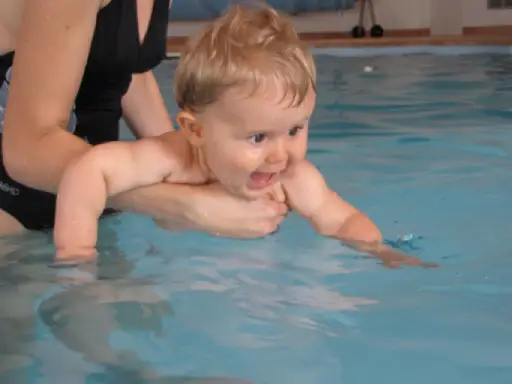
Because motor skills are still developing, full water acclimation for infants typically takes 6 to 12 months of gentle weekly play.
Child Swimming Timeline: Ages 1 to 7
While baby classes build comfort, age 4 is widely considered the ideal age for formal, unassisted lessons. At age 4, children can follow instructions, listen to a coach, and coordinate arm and leg movements together.
1. Ages 1 to 2 Years Old (The Toddlers)
- Goal: Overcoming fear, enjoying the water, and blowing bubbles.
- Timeline: 6 to 12 months of parent-assisted lessons.
2. Ages 3 to 4 Years Old (The Preschoolers)
- Goal: Submerging face, kicking with a kickboard, and swimming short distances unassisted.
- Timeline: 4 to 6 months to swim short distances safely.
3. Ages 5, 6, and 7 Years Old (The Big Kids)
Ages 5 through 7 represent the “golden window” for learning to swim. Stronger muscles allow kids in this group to learn very fast.
- Goal: Proper freestyle, backstroke, rhythmic breathing, and treading water.
- Timeline: 2 to 4 months of regular weekly lessons.
5 Practical Tips to Learn How to Swim Faster
If you want to speed up the learning process, keep these 5 strategies in mind:
- Practice, Practice, Practice: Weekend pool visits to play reinforce what was learned during structured lessons.
- Encourage Water Bravery: A child willing to put their head underwater learns mechanics twice as fast.
- Practice at Home: Try blowing bubbles or floating in the bath to build comfort naturally.
- Choose a Patient Teacher: A supportive instructor reduces anxiety and encourages kids to attempt new skills.
- Maintain Lesson Consistency: Taking breaks longer than two weeks causes skill regression.
Overcoming Water Anxiety and Progress Plateaus
Overcoming Water Anxiety Naturally
It is completely normal for children to feel nervous near deep water. Forcing a frightened child underwater increases anxiety and slows down progress. Instead, let them sit on the edge or play with water toys until curiosity replaces fear. A relaxed child learns significantly faster.
Why Progress Sometimes Slows Down
Parents often notice progress slowing down around the 3-month mark. This is called a plateau and usually happens when learning rhythmic breathing. Turning the head to breathe without stopping body movement is the hardest physical skill in swimming. Be patient during this phase—once breathing clicks, progress speeds right back up!
Essential Swimming Safety Rules for Parents
Even after a child learns to swim, adult supervision is critical. According to the Red Cross, formal swimming lessons reduce the risk of drowning by up to 88%.
- Maintain Touch Supervision: Always stay within arm’s reach of toddlers and beginner swimmers.
- No Running: Pool decks get slippery; enforce walking rules around water.
- Use Coast Guard-Approved Life Jackets: Never rely on inflatable arm floaties or foam toys as safety devices in deep water.
Summary: What to Expect for Your Child
- Toddlers (Ages 1–2): About 1 year to become fully comfortable and learn basic floating.
- Preschoolers (Ages 3–4): About 4 to 6 months to swim short distances alone.
- School Kids (Ages 5–7): About 2 to 4 months to master basic strokes.
Whether your child is 1 or 7, starting today builds a life-saving skill that lasts a lifetime!
Swimming is a gift that lasts a lifetime. It keeps kids healthy and safe. Whether your child is 1 or 7, today is a great day to start! After a long day at the pool, enjoy these 10 Easy Moral Stories for Kids before bedtime.”
1.What is the best age for a child to learn to swim?
Experts suggest that age 4 is the “golden age” for formal lessons because children can follow instructions. However, infant swim lessons (6 months to 2 years) are excellent for building water confidence early.
2.How long does it take to learn how to swim for a 7-year-old?
For kids aged 5 to 7, it usually takes 2 to 4 months of consistent weekly lessons. Since they are physically stronger, they master strokes like freestyle much faster than younger toddlers.
3.Can a child learn to swim in 10 days?
In 10 days of intensive daily lessons, a child can learn basic safety skills like floating and kicking. However, becoming a confident swimmer who can do proper strokes usually requires 20 to 30 hours of practice.
4.Why is my child not progressing in swimming lessons?
It is normal for kids to hit a “plateau,” especially when learning to breathe while swimming. Don’t worry! Consistency is key. Keep taking them to the pool, and they will eventually overcome the fear or technical difficulty.
5.Is it ever too late for a 7-year-old to start?
Never! While starting early helps, a 7-year-old has better focus and muscle strength. They often catch up to their peers very quickly due to their ability to understand coaching better.
Looking for engaging bedtime reading after a fun day at the pool? Check out our collection of 10 Easy Moral Stories for Kids to end the day with inspiring lessons! Check out more educational resources on our blog.
Suggested For You